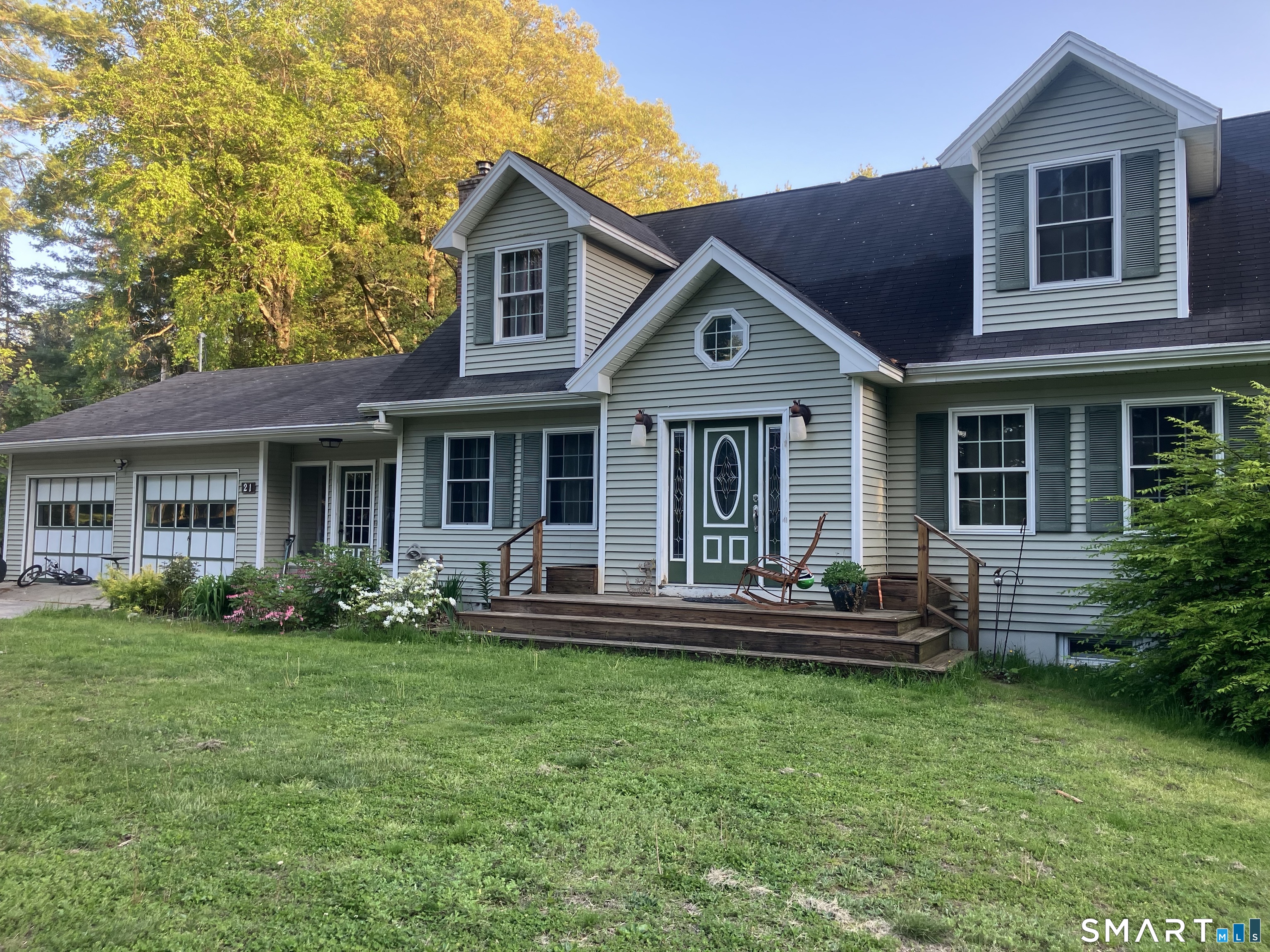
Eighteen houses sold in Franklin in all of 2025. That is one and a half closings a month across the entire town. The median was $353,745, and Franklin was one of only two towns in New London County where homes sold below asking — 99.3% of list. With 1,863 residents and a mill rate of 21.25, Franklin is one of the smallest and least-taxed towns in the region, and buying here works differently than buying anywhere with real volume.
Metric | 2025 | 2024 |
Median sale price, single-family | $353,745 | $322,500 |
Closed sales | 18 | 22 |
Median days on market | 26 | 22 |
Percent of list price received | 99.3% | 100.5% |
Full calendar year, single-family detached. Source: SmartMLS Local Market Update, December 2025.
Eighteen sales is the smallest sample in New London County, and it is small enough that I want to be explicit about what these figures can and cannot tell you.
The median of a set of 18 is simply the 9th and 10th houses that happened to sell. One estate sale, one unusually large property, one new construction — any of these visibly moves the number. The reported 9.7% year-over-year increase should not be read as "Franklin homes appreciated 9.7%." It should be read as "the middle of what sold in 2025 was 9.7% higher than the middle of what sold in 2024," which is a genuinely different statement.
The same caution applies to the 99.3% of list. In an 18-sale market, two or three properties that sat and then reduced will drag that figure below 100 regardless of what the healthy part of the market did.
What this means practically: in Franklin, town-level statistics cannot price your house. There may be only two or three genuine comparables for a given property, and they may be more than a year old, requiring adjustment. This is a town where the analysis has to be built property by property, and where knowing what actually traded — and what fell apart before it traded — matters far more than a market report.
Franklin's mill rate is 21.25, confirmed in the town's own Legal Notice published in January 2026.
That is genuinely low. Around it: Bozrah 23.50, Lisbon 26.70, Griswold 27.87, Salem 30.20, Sprague 30.40, Montville 31.43, Norwich's general fund rate 34.15.
On a $353,745 house — the town median — assessed at Connecticut's standard 70% of market value, the assessment is about $247,600. At 21.25 mills that is roughly $5,262 a year.
Compare that to the same-priced house in Montville at 31.43 mills — about $7,783 — and Franklin's rate is worth roughly $2,500 a year to a household. Over a ten-year hold that is $25,000, and it is a real part of what you are buying.
Why the rate is low is not a mystery: a very small town with a single PK–8 school, no high school to fund directly, minimal municipal infrastructure, and a substantial agricultural land base assessed under Connecticut's farmland program. Franklin does not spend much because Franklin does not have much to spend on. That is the trade, and it is worth naming honestly: low taxes here come with limited municipal services.
Franklin Elementary School serves the entire town PK–8 with roughly 185 students — and it has been recognized as a Connecticut School of Distinction.
That designation is the state's recognition for schools performing at a high level on its accountability measures, and for a school of 185 students in a town of 1,863 it is a meaningful credential. It is also, in my experience, the single most under-marketed asset in Franklin real estate. Buyers looking at small rural towns often assume small means limited. Here the state's own assessment says otherwise, and a listing that mentions it is doing the buyer a favor.
Roughly 20 students per grade level means every child is known by name, and it means a small social world. Both are true.
Franklin has no high school. Students go on to Norwich Free Academy and other regional options with the town paying tuition. NFA is a school of choice whose sending communities fund tuition, and Franklin is one of its partner communities alongside Norwich, Bozrah, Brooklyn, Canterbury, Lisbon, Preston, Sprague and Voluntown. Whether partner-community status carries a guaranteed seat is something I could not verify — ask NFA and the Franklin superintendent's office directly, and get the answer before you buy if high school placement is a deciding factor.
Franklin maintains an Agriculture and Conservation Commission, and the town publishes guidance on the Public Act 490 Conveyance Tax. Both tell you something real about the place.
Public Act 490 is Connecticut's farm, forest and open space program. It lets qualifying land be assessed at its use value rather than its market value, which dramatically reduces the property tax on working farmland and managed woodland. In a town like Franklin, a large share of the land is in it.
Here is the part that catches buyers and sellers off guard: PA 490 land carries a conveyance tax on sale. If classified land is sold or its classification changes within a defined period after it entered the program, a conveyance tax is owed on the transfer, calculated on a sliding scale that decreases the longer the land was classified. It is paid at closing.
What I tell people, specifically:
If you are buying a property in Franklin with acreage, ask during diligence whether any of the land is classified under PA 490 and, if so, when it was classified. Then ask your attorney whether the transaction triggers the conveyance tax and who is paying it. This gets negotiated, and the party who understands it first tends to win that negotiation.
If you are buying classified land and intend to change its use — subdivide it, build on it, stop farming it — understand that removing land from PA 490 has consequences beyond the conveyance tax, including a reset to full market assessment. A parcel that looked affordable to carry may not be once you change what it is.
I would rather flag this early than have a client discover it a week before closing. It is not a reason to avoid Franklin. It is a reason to have your attorney look at it properly.
Franklin re-adopted its Plan of Conservation and Development in January 2026, which is the document that signals where a town intends to go. If you are buying with any long-term development question in mind, that plan is public and worth reading.
Franklin sits between Norwich, Lebanon and Bozrah, rural and quiet, with the Dr. Ashbel Woodward Museum as its principal historic site — the home of a nineteenth-century physician, preserved as a town museum.
The median household income is around $105,000, which is high relative to the region and consistent with what small-town Franklin actually is: established households, high owner-occupancy, very little turnover. Eighteen sales a year is the arithmetic result of people not leaving.
A scheduling detail that will genuinely save you a wasted trip: Franklin's Assessor is open Tuesdays only — 9 a.m. to 3 p.m. and again 6 to 8 p.m.
That is not a criticism; it is what a town of 1,863 people can staff. But it has real consequences for a transaction. If you need an assessment record, a field card, or a question answered about a PA 490 classification, you have one day a week. Build that into your inspection contingency timeline rather than discovering it on a Wednesday. The evening hours are a genuine convenience for working buyers — use them.
Confirm all town office hours by phone before you drive. Small towns adjust schedules.
Franklin is well outside the crumbling-concrete foundation area. The 20-mile radius defining Connecticut's crumbling foundation program is centered on the former J.J. Mottes Concrete Company in Stafford Springs, far to the northwest. That issue drives inspection strategy in Tolland and Windham County. It is not a Franklin concern.
Septic and well permits go through the Uncas Health District, which serves Franklin along with Bozrah, Griswold, Lebanon, Lisbon, Montville, Norwich, Preston, Salem, Sprague and Voluntown. Franklin is entirely a well-and-septic town. Pull the Uncas permit history on any house you are serious about. The installation date and permitted bedroom count of a septic system are among the most consequential and most commonly skipped items in a rural Connecticut purchase — and the permitted bedroom count can quietly limit what you are allowed to do with the house later.
Eighteen sales means your house will not compete for attention — and it also means a buyer has almost nothing to measure it against. That cuts both ways and it is the central fact of selling here.
Three things I would prepare.
Do not accept a price derived from town medians. In an 18-sale market, an automated valuation is a guess. Ask whoever prices your house which specific properties the number came from, and whether those properties are actually like yours. If the answer is vague, get another opinion.
Lead with the tax rate. Franklin at 21.25 mills against Montville's 31.43 or Sprague's 30.40 is worth thousands of dollars a year to a buyer, and it is the strongest single argument this town has. Most Franklin listings never mention it. Put the actual annual figure in the marketing — not the mill rate, the dollar amount — because buyers respond to a number they can put in a mortgage calculator.
Sort out the PA 490 question before you list, not during the inspection period. If you have classified land, know when it was classified and what a sale triggers. A seller who brings that to the table looks competent. A seller whose buyer's attorney discovers a conveyance tax obligation two weeks before closing is renegotiating from a weak position.
If you want a real number for your home, I will walk the property, find the handful of comparables that genuinely apply, and tell you honestly what I think it brings.
Single-family homes sold at a median of $353,745 in 2025 across just 18 sales — the smallest sample in New London County. Homes sold at 99.3% of list in a median of 26 days. With 18 sales, the median reflects which particular houses happened to trade rather than town-wide appreciation; treat it as direction, not precision. Source: SmartMLS Local Market Update, December 2025.
21.25 mills, confirmed in the town's Legal Notice published January 2026 — among the lowest in the region, against Bozrah's 23.50, Griswold's 27.87, Sprague's 30.40 and Montville's 31.43. On a $353,745 house assessed at 70% of value, that is roughly $5,262 a year.
No. Franklin Elementary School serves the whole town PK–8 with about 185 students and has been recognized as a Connecticut School of Distinction. High schoolers attend Norwich Free Academy and other regional options with the town paying tuition. Confirm current placement rules with the district if this matters to your purchase.
Public Act 490 is Connecticut's farm, forest and open space program, which assesses qualifying land at use value rather than market value. When classified land is sold or declassified within a defined period, a conveyance tax is owed at closing on a sliding scale that decreases the longer the land was classified. Franklin publishes guidance on it. If you are buying acreage here, ask whether the land is classified, when it was classified, and who pays the conveyance tax — and have your attorney confirm it.
Tuesdays only, 9 a.m. to 3 p.m. and 6 to 8 p.m. That is one day a week, which matters when you are working against an inspection contingency deadline. The evening hours are useful for working buyers. Confirm by phone before driving.
About 1,863 residents, with a median household income near $105,000. It is a rural, agricultural town between Norwich, Lebanon and Bozrah, home to the Dr. Ashbel Woodward Museum. Its Plan of Conservation and Development was re-adopted in January 2026.
No. Franklin is far outside the 20-mile radius around the former J.J. Mottes Concrete Company in Stafford Springs that defines Connecticut's crumbling foundation program area.
Sources and dates. Sale price, closed sales, days on market and percent of list received: SmartMLS Local Market Update, December 2025, single-family detached, full-year 2025 and 2024. Mill rate: Town of Franklin Legal Notice, January 2026. Comparison mill rates: Connecticut Office of Policy and Management and the respective towns. Public Act 490 program and conveyance tax: Connecticut General Statutes and Town of Franklin guidance. Agriculture and Conservation Commission and Plan of Conservation and Development re-adoption, January 2026: Town of Franklin. Schools, enrollment and School of Distinction recognition: Franklin Elementary School and Connecticut State Department of Education. Norwich Free Academy partner communities: Norwich Free Academy. Assessor hours: Town of Franklin. Population and median household income: U.S. Census Bureau. Dr. Ashbel Woodward Museum: Town of Franklin. Health district: Uncas Health District. Crumbling foundations radius: Connecticut Department of Housing.
Last updated August 2026. Tax rates and market data change — ask me for current numbers.