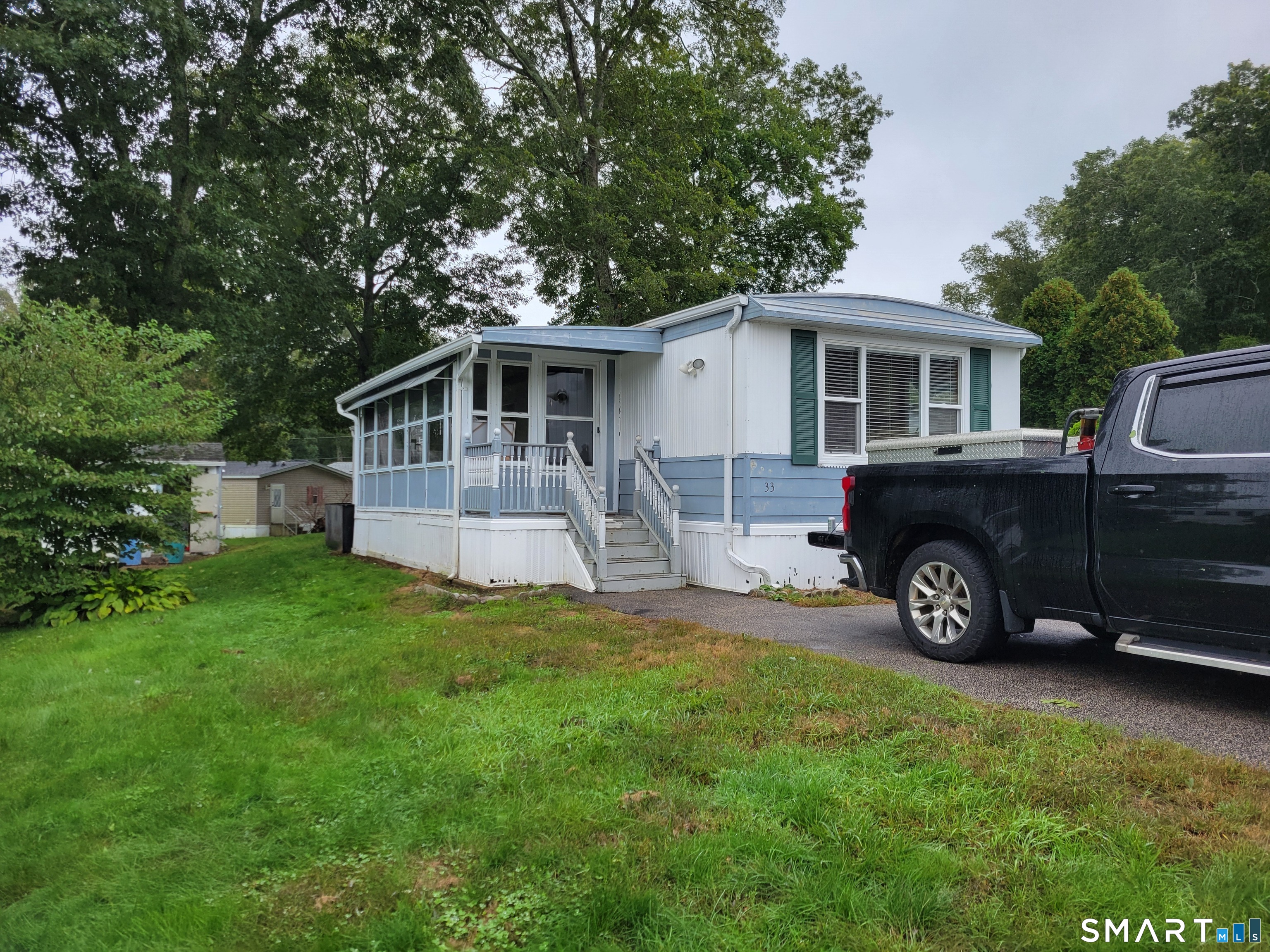
North Stonington's mill rate fell from 28.88 to 17.50 — a 39% drop. Almost nobody's tax bill fell 39%. The town revalued on the October 1, 2025 Grand List, and the whole grand list jumped 52.1%, with real estate alone up 61.9%. The rate came down to collect roughly the same money. Meanwhile the market did something genuinely dramatic: median days on market went from 39 to 15, the sharpest speed-up of any town in New London County.
I sell all over New London County, and this is the town where I spend the most time clearing up the same two misunderstandings. So let me get both out of the way.
Metric | 2025 | 2024 |
Median sale price, single-family | $460,000 | $425,000 |
Closed sales | 53 | 62 |
Median days on market | 15 | 39 |
Percent of list price received | 102.2% | 100.3% |
Full calendar year, single-family detached. Source: SmartMLS Local Market Update, December 2025.
Days on market fell by 62% while the percent of list rose from 100.3% to 102.2%. Faster and stronger at the same time, on fewer sales — 53 against 62. When sales drop and both speed and price climb, that's scarcity doing the work. Fewer houses came available, and the ones that did got absorbed almost immediately and bid above asking.
If you're buying here, your diligence window is short and the competition is real. If you're selling, the pricing decision matters a lot more than the marketing budget.
This is the most important thing on this page, and I'd rather hand you the arithmetic than a reassurance.
North Stonington revalued on the October 1, 2025 Grand List. Assessments reset to current market value. Here's what came out of it:
Total grand list change | +52.1% |
Real estate component change | +61.9% |
Mill rate | 28.88 → 17.50 |
When the tax base grows 52% and the town still needs the same revenue, the rate has to fall by roughly the same proportion. It did. That 39% reduction is arithmetic. Nobody sat down and decided to lower your taxes.
Here's the practical rule for North Stonington this year. Old rate 28.88, new rate 17.50. The ratio is 28.88 ÷ 17.50 ≈ 1.65.
If your assessment rose about 65%, your tax bill is roughly unchanged.
If your assessment rose more than 65%, your bill went up.
If your assessment rose less than 65%, your bill went down.
Now, real estate specifically rose 61.9% — close to that 65% breakeven but a little under it. So the typical house should land roughly flat to slightly lower, while anything that appreciated faster than the town average is paying more.
Do this before you make an offer: take the seller's new assessment, multiply by 0.01750, and that's your annual town tax. Don't take the seller's last tax bill and assume it carries forward. It was figured at 28.88 on a pre-revaluation assessment, and it's meaningless now. And if anybody tells you North Stonington "lowered taxes," ask them what happened to the assessment.
On a $460,000 house — the town median — assessed at 70% of market value, the assessment is $322,000. At 17.50 mills that's roughly $5,635 a year. That's genuinely low for this region. It's low because North Stonington's rate sits low against its neighbors even after you adjust for the revaluation, and the revaluation itself has nothing to do with it.
Wheeler High School enrolls roughly 190 students across all four grades. That's small enough to define the town, and it's the thing I want buyers talking about honestly before they commit to anything.
What small gets you: teachers who know every kid by name. A real shot at playing a varsity sport or holding a leadership spot instead of fighting for one. A school where a kid can't disappear.
What small costs you: a thinner slate of Advanced Placement offerings & fewer specialized electives. Fewer teams and clubs. A smaller social world for a teenager who doesn't click with it. Small schools are wonderful for a lot of kids and constraining for some.
Neither one of those is a criticism. It's the actual trade, and it's a real one. If you've got high-school-age children, or expect to, tour Wheeler before you buy in North Stonington. It's the single biggest lifestyle variable in this town, and it's the one listing copy skips right past.
North Stonington runs its own PK–12 district on a shared campus, so kids stay in one system from kindergarten straight through graduation.
North Stonington sits right on the Rhode Island line, up against Westerly and Hopkinton. Buyers looking here are almost always looking over there too, and the two states are meaningfully different to own property in.
What actually changes when you cross that line: state income tax treatment, motor vehicle taxation, property tax structure and rates, school districts, and — if you're relocating for work — possibly your withholding and filing situation. Connecticut and Rhode Island tax residents differently enough that two households earning about the same money can face a very different total burden depending on which side of the border they sleep on.
I'm licensed in Connecticut, Rhode Island and Massachusetts, so when you're weighing North Stonington against Westerly I can actually show you both and represent you in either one. Not every agent in this corridor can do that, and it matters if the border is a real part of your decision rather than an accident of geography.
What I won't do is tell you which state is cheaper for you. That depends on your income, your household and your specific property, and it's a question for your accountant. What I will do is make sure you're comparing real houses on both sides instead of guessing.
North Stonington doesn't host either casino. It still collects, per resident, roughly twice what Ledyard gets and thirty-five times what Griswold gets.
Town | FY2027 grant | Per resident |
$1,165,290 | ~$243 | |
North Stonington | $880,690 | ~$171 |
Ledyard (hosts Foxwoods) | $1,391,000 | ~$90 |
Montville (hosts Mohegan Sun) | $1,446,162 | ~$79 |
$2,360,229 | ~$59 | |
Griswold | $55,478 | ~$4.87 |
The money comes out of the Mashantucket Pequot and Mohegan Fund, and it tracks reservation adjacency and historical impact rather than which town the casinos happen to sit in. For a town of roughly 5,100 people, $880,690 a year is a real component of the budget — and it's part of why North Stonington's mill rate holds up well against neighbors with far more commercial tax base.
I couldn't verify the statutory formula behind the distribution — the state's explanatory pages wouldn't load. The dollar amounts come from Connecticut's own statutory aid data and those are solid.
North Stonington is well outside the crumbling-concrete foundation area. That 20-mile radius defining Connecticut's crumbling foundation program is centered on the former J.J. Mottes Concrete Company in Stafford Springs, way up to the northwest. It drives how I handle inspections in Tolland and Windham County. Down here it isn't a concern.
Septic and well permits run through the Ledge Light Health District, which also covers East Lyme, Groton, Ledyard, Lyme, New London, Old Lyme, Stonington and Waterford. North Stonington is overwhelmingly a well-and-septic town. Pull the Ledge Light permit history on any house you're serious about. The installation date and the permitted bedroom count on a septic system are two of the most consequential things you can look up out here, and two of the most commonly skipped.
The town is rural, low-density and mostly wooded, with the village of North Stonington and Clarks Falls as its main settlement nodes. Interstate 95 clips the southern end, which is why somewhere this rural is still a straightforward commute to Westerly, Mystic, Groton and the shoreline employers.
Fifteen days at 102.2% of asking is one of the strongest combinations in the county, and it happened while inventory was falling. You're selling into scarcity.
Two things I'd get ready.
Have the revaluation answer ready, in writing. Every buyer looking at North Stonington in 2026 sees a mill rate that fell 39% and reacts one of two ways. They assume a windfall, or they assume a catch. Both reactions cost you. The seller who hands over the new assessment, multiplies it by 0.01750 and shows the buyer the actual annual number has killed the whole issue on a single page. The rate is the wrong number to talk about. The bill is the right one.
Deal with the school head on instead of hoping it doesn't come up. Buyers with teenagers are going to find out Wheeler enrolls about 190 students. Framing it honestly — this is a small school, here's what that means, here's who does well here — reads as confidence. Silence reads as concealment, and that's what kills deals at the eleventh hour.
If you want a real number for your home, I'll walk the property, pull the actual post-revaluation comps, and tell you honestly what I think it brings.
And if part of what you're weighing is whether you need me at all — some people genuinely don't, and I'll tell you so — I wrote a straight piece on selling your house without an agent in Connecticut. It covers where doing it yourself actually works, what AI is genuinely good at now, and why an automated price struggles in a town that closes 53 homes a year.
Single-family homes sold at a median of $460,000 in 2025, up from $425,000 in 2024, across 53 sales — down from 62. They went at 102.2% of list in a median of 15 days, way down from 39 days the year before. Source: SmartMLS Local Market Update, December 2025.
17.50 mills, down from 28.88. Don't read that as a tax cut. The town revalued on the October 1, 2025 Grand List, and the grand list rose 52.1% overall with real estate up 61.9%. On a $460,000 house assessed at 70% of value, 17.50 mills runs roughly $5,635 a year.
For some owners yes, for others no. The breakeven is roughly a 65% assessment increase, which is just the old rate divided by the new one. If your assessment rose more than about 65%, your bill went up despite the lower rate. If it rose less, your bill went down. Real estate assessments rose 61.9% on average, a little under breakeven, so the typical residential bill should be roughly flat to slightly lower.
Roughly 190 students across all four grades, which makes it one of the smallest high schools in Connecticut. You get small classes, accessible sports and leadership roles, and teachers who know every student. You also get a narrower slate of AP courses, electives and activities than a big comprehensive school. Tour it before you buy if you've got high-school-age children.
Yes — it borders Westerly and Hopkinton directly. Buyers here compare Connecticut and Rhode Island properties all the time, and the two states differ meaningfully on income tax, motor vehicle tax and property tax structure. I'm licensed in Connecticut, Rhode Island and Massachusetts, so I can show you and represent you on either side of that border.
North Stonington gets $880,690 for FY2027 out of the Mashantucket Pequot and Mohegan Fund — about $171 per resident, roughly twice Ledyard's per-capita share even though Ledyard hosts Foxwoods. The formula follows reservation adjacency and historical impact rather than which town the casinos are in.
No. The town sits far outside the 20-mile radius around the former J.J. Mottes Concrete Company in Stafford Springs that defines Connecticut's crumbling foundation program area.
North Stonington borders 5 of the other towns I cover, and people looking here almost always look at a couple of them too. Same guide, same numbers, for each one:
Or see how every town in the county compares side by side in my New London County real estate guide.
Sources and dates. Sale price, closed sales, days on market and percent of list received: SmartMLS Local Market Update, December 2025, single-family detached, full-year 2025 and 2024. Mill rate, prior rate, grand list change and revaluation year: Town of North Stonington and Connecticut Office of Policy and Management. Revaluation schedule: CT Revaluation Years by Town, 2023-2037. Mashantucket Pequot and Mohegan Fund grants by town: Connecticut statutory aid data, FY2027. Schools and enrollment: North Stonington Public Schools. Health district: Ledge Light Health District. Population: U.S. Census Bureau. Crumbling foundations radius: Connecticut Department of Housing.
Last updated August 2026. Tax rates and market data change — ask me for current numbers.